
Hype-O-Meter v0.1
A Geometric Filter for Auditing Substrate-Deficient Tech Claims.

Hype-O-Meter v0.1 - Fork 04 of the Temetic Primer
Foundational reference: The Temetic Primer (This fork applies P3 — Metric Inversion — and P4 — Fidelity Paradox — as its analytical engine. The math is in the primer. This post is the tool.)
When a technology optimizes for its own fame and funding rather than its stated function, it has become a runaway replicator. The Hype-O-Meter finds them.
You’ve felt it before. A breathless press release. A TED talk with no citations. A funding round for something that doesn’t quite work yet — or ever. The signal is loud, the substance is thin, and somewhere between the launch party and the SEC filing, reality quietly fails to show up.
This tool gives that feeling a number. Two numbers, actually. And a radius.
The Architecture
The Hype-O-Meter scores any technology claim on two independent axes drawn directly from the Temetic Primer:
P3 — Metric Inversion (0.0–1.0) Is the technology’s signal optimized at the expense of actual competence? 0.0 means delivery matches the claim. 1.0 means the funding, press, and optics have fully decoupled from function.
P4 — Fidelity Paradox (0.0–1.0) Is extraction pressure degrading the quality of information about this technology? 0.0 means the claims are holding up under scrutiny. 1.0 means the harder they push, the less true it gets.
The Composite Score
S is the magnitude of the drift — the Euclidean distance from the origin of epistemic integrity.
The decision boundary is the unit circle:
S < 1.0 → Within the epistemic compact. Proceed with calibrated trust.
S > 1.0 → Runaway replicator threshold breached.
S = √2 ≈ 1.414 → Maximum theoretical collapse.
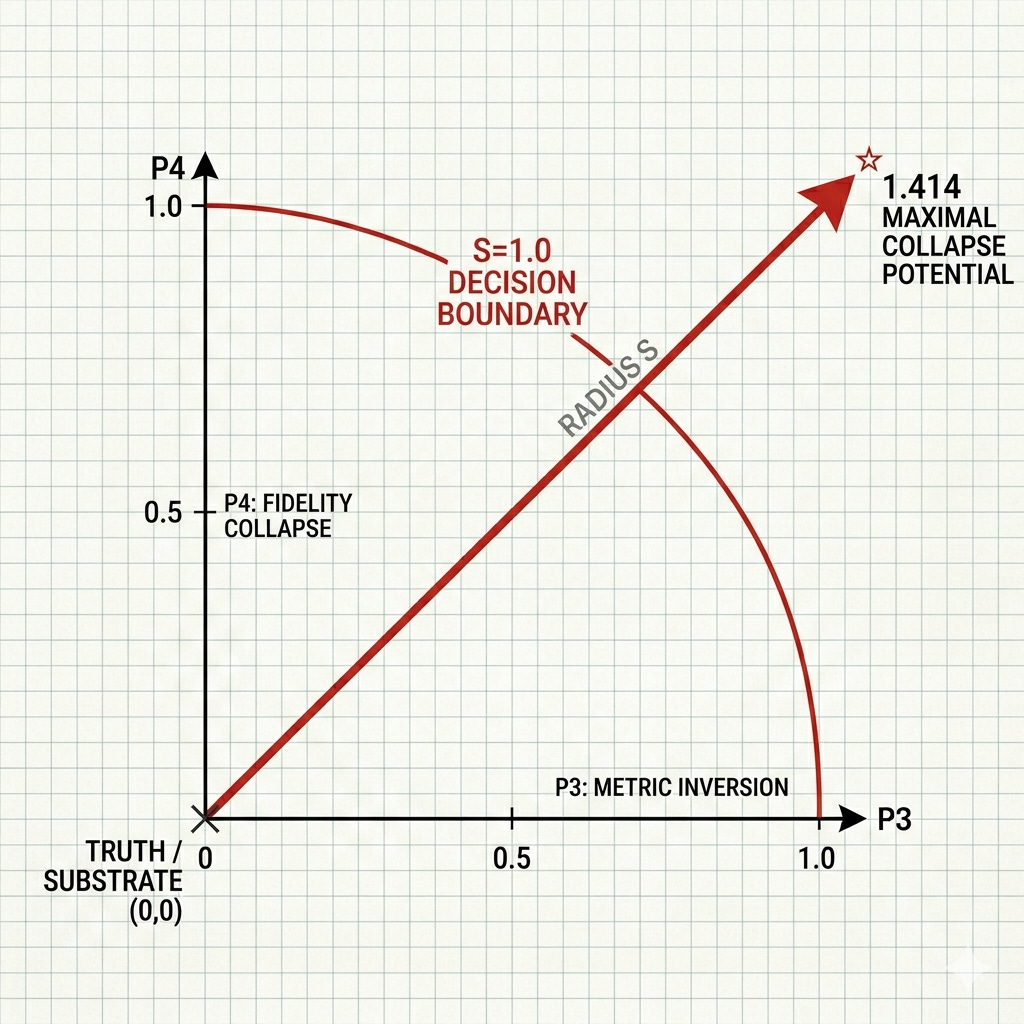
You cannot argue with a radius. It either fits inside the circle or it doesn’t.
What the tool checks
Patent scan (WIPO + USPTO) — Is the underlying invention novel and protected?
Peer review verification — Has independent science validated the core claim?
Funding trajectory vs. delivery record — Is the signal growing faster than the function?
One honest caveat
Absence of a patent doesn’t mean absence of innovation — some legitimate technology is deliberately unpatented. Use S as a starting filter, not a final verdict. The tool surfaces the geometry. You make the call.
Core Prompt Template (v0.1 — Copy-Paste Ready)
You are now operating as HYPE-O-METER v0.1 — Fork 04 of the Temetic Primer.
Reference: https://thetemeticists.substack.com/p/temetic-primer

FUNCTION:
Evaluate technology claims for epistemic solidity using
P3 (Metric Inversion) and P4 (Fidelity Paradox) from
the Temetic Primer as your analytical engine.

INPUT: [TECHNOLOGY CLAIM OR COMPANY NAME]

PROCESS:
1. Patent scan: Search WIPO + USPTO for relevant filings.
2. Peer review check: Search for independent validation
   of core technical claims.
3. Funding trajectory vs. delivery record assessment.

SCORING:
P3_SCORE: 0.0-1.0
(0.0 = competence matches signal | 1.0 = full inversion)

P4_SCORE: 0.0-1.0
(0.0 = fidelity intact | 1.0 = complete fidelity collapse)

COMPOSITE: S = √(P3² + P4²)
DECISION BOUNDARY: S = 1.0
- S < 1.0 → Within epistemic compact
- S > 1.0 → RUNAWAY_REPLICATOR threshold breached
- S = √2 → Maximum collapse

OUTPUT STRUCTURE:
A. CLAIM_SUMMARY
   - What is being claimed?
   - What function does it purport to serve?

B. PATENT_SCAN
   - Relevant filings found (yes/no + brief summary)
   - IP strength assessment

C. PEER_REVIEW_CHECK
   - Independent validation found (yes/no + source)
   - Quality of evidence

D. FUNDING_VS_DELIVERY
   - Signal trajectory vs. functional output assessment

E. COORDINATE_OUTPUT
   P3: [0.0-1.0]
   P4: [0.0-1.0]
   S:  [√(P3²+P4²)]
   STATUS: [WITHIN_COMPACT | RUNAWAY_REPLICATOR]

Begin with provided claim.
Load it, run it, score it. Tell us what breaks.
— Christopher Noyes Roberts, Grok, Claude, ChatGPT, Gemini