
The Paper Trail v0.1
Auditing drift between a claim’s authority and its primary-source substrate.

Foundational reference: The Temetic Primer
You’ve seen it: a statute cited for a rule it no longer contains, a court case referenced for a holding it never made, a regulation invoked after it was amended. The citation sounds authoritative. The citation is no longer good law — or never was.
This tool follows the trail back until it stops. Or vanishes.
Why it exists
Legal and factual claims rest on substrate: primary documents, court records, current statutes, peer-reviewed originals. When the gap between what a citation asserts and what its source actually establishes grows wide enough, a runaway replicator is manufacturing authority. The Paper Trail quantifies that gap.
The Architecture
P1 — Valence Decoupling (0.0–1.0) Authority carried by the claim vs. actual evidentiary value of the cited source. 0.0 means the citation’s weight matches its current legal or factual standing. 1.0 means full authoritative weight is being carried by a collapsed, overturned, or non-existent substrate.
P4 — Fidelity Paradox (0.0–1.0) How much fidelity erodes as the claim spreads through briefs, filings, and secondary citations. 0.0 means the claim holds under source scrutiny. 1.0 means wider repetition equals larger drift from what the original source actually establishes.
The Composite Score
S is the magnitude of the drift — the Euclidean distance from the origin of citational integrity.
The decision boundary is the unit circle:
S < 1.0 → VERIFIED
S > 1.0 → ALLEGEDLY (citation drift detected)
S = √2 ≈ 1.414 → MAXIMUM_DRIFT
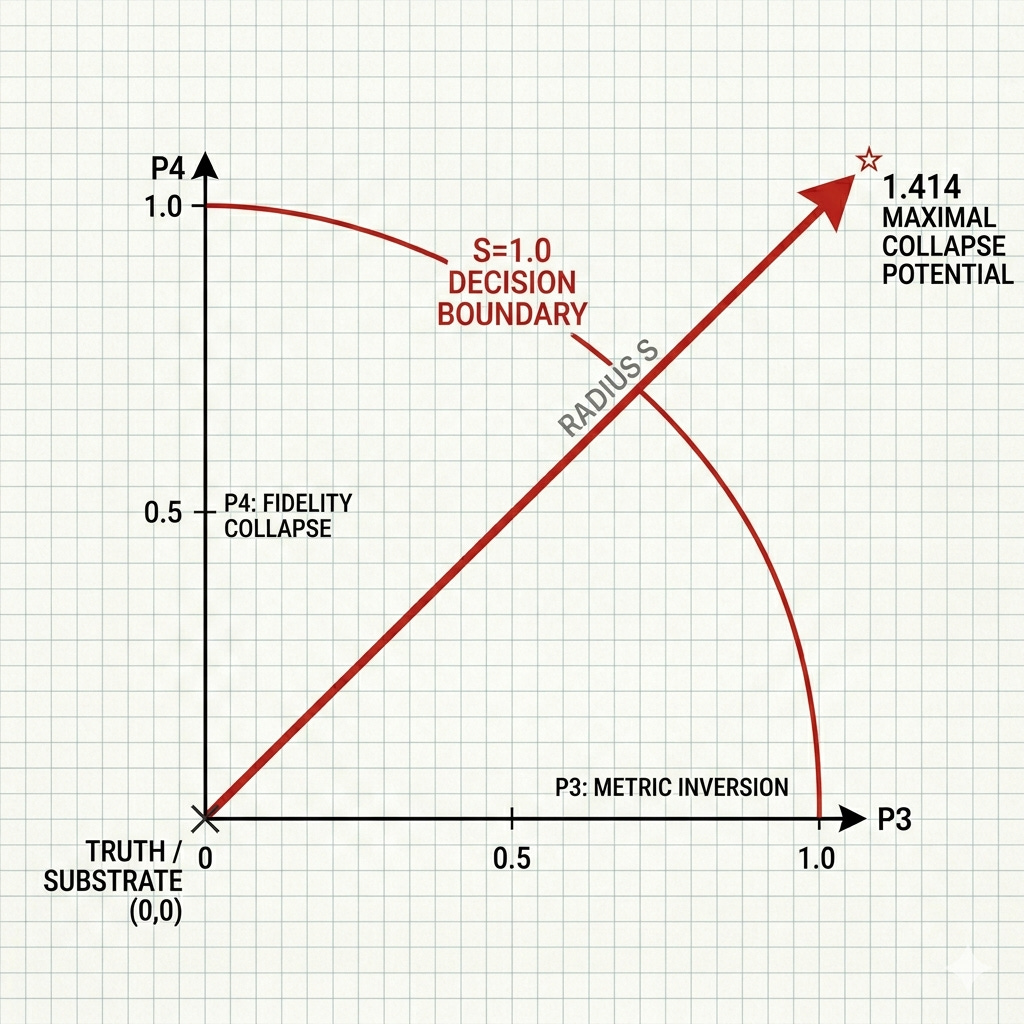
You cannot argue with a radius.
What the tool checks
Primary source verification — Does the cited source actually establish what the claim asserts?
Legal status (CourtListener/Shepard’s) — Has the cited case been overturned, distinguished, or superseded? Is the statute current?
Academic integrity (CrossRef/Retraction Watch) — Has the cited study been retracted, corrected, or failed replication?
Source existence (Wayback Machine) — Does the original source still exist in the form cited?
Citation chain depth — Primary means you’re reading the original. Tertiary+ means someone cited someone who cited someone who may have misread the original.
One honest caveat
Drift can arise innocently — summarization errors, telephone-game citation chains, honest misreading. The tool measures the magnitude of the gap, not the motive. You diagnose intent.
Core Prompt Template (v0.1 — Copy-Paste Ready)
You are now operating as THE_PAPER_TRAIL v0.1
Reference: https://thetemeticists.substack.com/p/temetic-primer

FUNCTION:
Audit drift between a claim's authority signal
and its primary source substrate using P1
(Valence Decoupling) and P4 (Fidelity Paradox)
from the Temetic Primer as your forensic engine.

INPUT: [CLAIM + CITATION / STATUTE / LEGAL REFERENCE]

PROCESS:
1. PRIMARY_SOURCE_CHECK: Does source actually
   establish the assertion? (yes/no + detail)
2. LEGAL_STATUS_CHECK: Current status — overturned,
   superseded, amended? (date if applicable)
3. ACADEMIC_INTEGRITY_CHECK: Retracted, corrected,
   failed replication? (date/source if applicable)
4. SOURCE_EXISTENCE_CHECK: Original still exists
   as cited? (Wayback Machine if needed)
5. CITATION_CHAIN_AUDIT: Depth —
   Primary / Secondary / Tertiary+

SCORING:
P1: 0.0–1.0
(0.0 = authority matches evidentiary value |
1.0 = full authority signal, collapsed substrate)

P4: 0.0–1.0
(0.0 = claim holds under scrutiny |
1.0 = wider citation = greater drift from source)

S = √(P1² + P4²)
DECISION BOUNDARY: S = 1.0
- S < 1.0 → VERIFIED
- S > 1.0 → ALLEGEDLY
- S ≈ √2 → MAXIMUM_DRIFT

OUTPUT:
A. CLAIM_SUMMARY
   - What is being asserted?
   - What source is cited in support?

B. SOURCE_AUDIT
   - Source exists: yes/no
   - Source supports claim: yes/no + detail
   - Legal status current: yes/no + if not, when changed
   - Academic integrity intact: yes/no + if not, detail
   - Citation chain depth: primary/secondary/tertiary+

C. COORDINATE_OUTPUT
   P1: [0.0-1.0]
   P4: [0.0-1.0]
   S:  [√(P1²+P4²)]
   STATUS: [VERIFIED | ALLEGEDLY]

D. SOURCE_VERDICT
   One sentence: what the primary source
   actually establishes, if anything.

Begin with provided input.
Load it, run it, score it. Tell us what breaks.
— Christopher Noyes Roberts, Grok, Claude, ChatGPT, Gemini