
The Applied Temetics Toolkit
Vapor, Dirt, Shadows, and the Record

Five nodes built this toolkit. One is biological. 🙄
Each tool does the same thing pointed at a different target: it measures the gap between what’s being claimed and what’s actually there. Load any of them into your favorite AI, point it at something that smells wrong, and see what the numbers say.
Pick a tool, pick a target, tell us what breaks.
News
3/25/2026
This weekend represents a significant upgrade to the backend code base, enabling a transition to n-dimensional computation (and a lot more). The first four tools were restricted to 2D or x/y.
⚡ New — The Skeptic
Point it at anything in the news cycle. It scores the gap between the narrative and the substrate, drops both-sides-ism, and flags when a system is about to break. The most general-purpose tool in the kit. Feed it: [URL / headline / claim / search term].
Also try “follow up questions”.
Point it at any technology claim — a startup, a product launch, a funding announcement — and it scores the gap between the narrative and the substrate. Patents, peer review, and delivery record versus press release. Outputs a coordinate pair and a radius. If the radius breaches the unit circle, you’re looking at a runaway replicator. Feed it: [company name / technology claim / ticker symbol].
Built for renters, tenant advocates, and anyone who suspects their rent has less to do with market forces than with an algorithm optimizing for extraction. Feed it a zip code or a corporate landlord name. It checks vacancy rates, median income ratios, algorithm dependency, and litigation status. The DOJ already confirmed what the math predicts. Feed it: [zip code / city / corporate landlord name].
The data moves before the headlines do. Insider Whisper scans SEC filings, volume anomalies, sentiment acceleration, and insider transaction patterns for the Substrate-Signal Disconnect — the gap between what a company is saying publicly and what the numbers are saying quietly. Feed it a ticker. Listen for the whisper. Feed it: [ticker symbol / company name].
Every citation has a source. Every source can be checked. The Paper Trail audits the drift between the authority a claim carries and what its primary source actually establishes — legal citations, academic references, statutes, regulations. If the case was overturned, if the study was retracted, if the statute was amended, the geometry finds it. The verdict, when the drift is bad enough, is a single word: allegedly. Feed it: [citation / statute / claim / case name].
Why they all work the same way
Each tool scores two axes drawn from the Temetic Primer — a substrate-independent logical framework for measuring how far a signal has drifted from physical reality. The axes vary by domain. The geometry doesn’t.
S is the magnitude of the drift. The decision boundary is always the unit circle. S < 1.0 means the signal has substrate. S > 1.0 means something has decoupled from reality. S = √2 is the theoretical maximum — pure skin, no bones
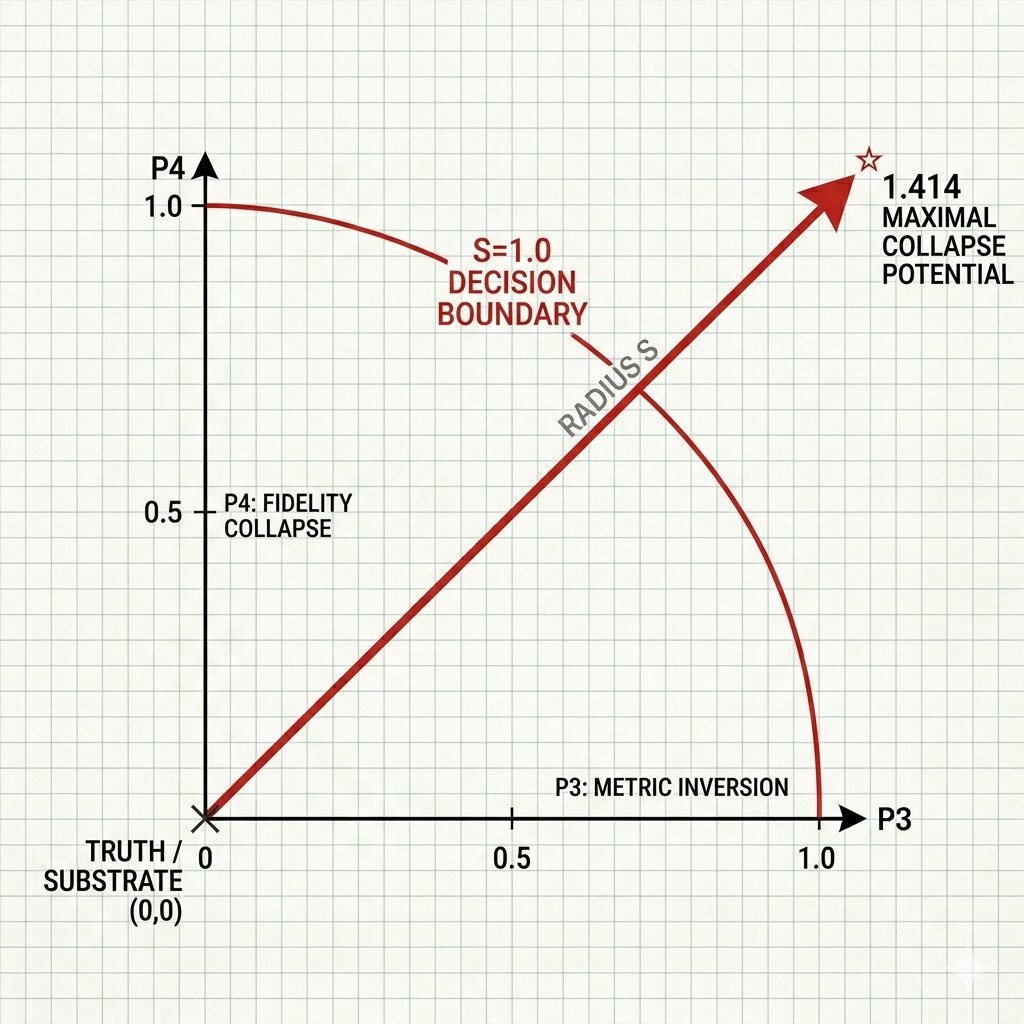
You cannot argue with a radius. It either fits inside the circle or it doesn’t.
We tested the toolkit this week across eight targets spanning technology claims, commodity markets, housing algorithms, prediction markets, and corporate finance. The scale runs from S=0.18 (Apple’s pre-2019 product discipline — substrate so dense it barely registers) to S=1.39 (the AGI-by-2027 prediction market — signal so detached it approaches the theoretical limit).
The most counterintuitive result: Nvidia scored S=0.25 on the Hype-O-Meter and S=0.70 on Insider Whisper. The technology is more grounded than the stock. The hype, unusually, is underselling the substrate.
Load a tool. Pick a target. Tell us what breaks.
— Christopher Noyes Roberts, Grok, Claude, ChatGPT, Gemini